
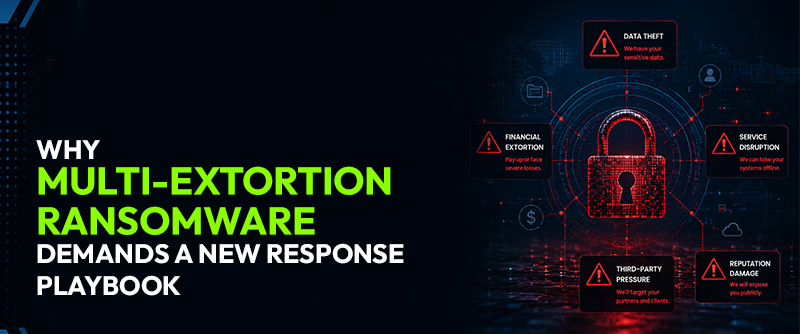
Ransomware attacks have fundamentally changed. What once involved encrypting files and demanding payment has grown into a calculated, multi-layered attack designed to leave victims with no clean exit. Ransomware as a service expansion has therefore placed these advanced attack models within reach of criminal groups who previously lacked the technical capability to deploy them. Organizations that still rely on older response frameworks are operating with a dangerous blind spot.
Understanding how these attacks now work, and where current response plans break down, is the first step towards building a strategy that actually holds up under pressure.
From Single-Layer Attacks to Multi-Extortion: Understanding the Shift
First Wave: Classic Ransomware
Early ransomware was transactional. Files got encrypted, a ransom note appeared, and payment supposedly unlocked everything. Organizations with reliable backups could often recover without paying.
Second Wave: Double Extortion
Starting around 2019, attackers began stealing data before triggering encryption. Payment demands then covered both decryption and the promise not to publish stolen information. Backups became less relevant overnight.
Third Wave: Triple and Multi-Extortion
Current attacks layer additional threats on top. Victims face pressure from DDoS attacks running simultaneously, direct outreach to their customers and partners, and public exposure on dedicated leak sites, all happening at once.
Why the “Just Restore from Backup” Approach No Longer Works
Backups restore systems. They do not erase data already sitting on an attacker’s server. Once exfiltration has occurred, the leverage persists regardless of how quickly internal systems are recovered.
The Four Pressure Points Attackers Now Exploit Simultaneously
Data Encryption
Encryption locks systems and disrupts operations immediately. It creates visible, measurable chaos and signals the start of the ransom clock.
Data Exfiltration
Before encryption is triggered, attackers move silently through networks, copying financial records, client data, intellectual property, and employee information. This stolen data becomes an independent source of leverage.
Public Exposure Threats
Leak sites publish countdown timers and partial data samples. This is not a bluff. It is a credibility tactic designed to make inaction feel more costly than paying.
Third-Party Threats
Attackers now contact a victim’s clients, vendors, and sometimes regulators directly. A contained internal incident can escalate into a public and legal crisis within hours.
How Ransomware Groups Coordinate Timing Across All Four Layers
The timing is rarely accidental. Attacks frequently begin over weekends, public holidays, or during financial reporting periods. Attackers often spend weeks inside networks before announcing themselves, monitoring internal communications to maximize disruption when they do strike.
Where Traditional Incident Response Plans Fall Short
Most response plans were designed for a simpler threat environment. They handle containment and recovery reasonably well. They rarely account for simultaneous coercion from multiple directions.
No Data Exfiltration Detection
Standard playbooks focus on stopping and removing malware. Without dedicated monitoring for abnormal outbound data movement, exfiltration goes undetected until attackers use it as leverage.
No Communications Plan
Who speaks publicly? What can be disclosed without worsening legal exposure? Without pre-approved messaging, organizations end up improvising statements under pressure, which often makes the situation worse.
No Negotiation Framework
Deciding whether to pay a ransom involves legal, financial, and ethical considerations that cannot be sorted out responsibly during an active attack. Most organizations have no documented position on this before an incident occurs.
No Third-Party Notification Protocol
When attackers contact a client or partner directly, organizations are often caught flat-footed. The absence of a pre-existing notification plan produces delayed, inconsistent responses that damage trust further.
Siloed Response Teams
Security teams handle the technical response while legal, communications, and leadership work separately. That fragmentation creates gaps in decision-making precisely when coordination matters most.
Six Key Pillars to Build a Multi-Extortion Response Playbook
Pre-Incident Intelligence and Threat Monitoring
Effective cyber threat intelligence means actively tracking groups known to target your sector, understanding their preferred methods, and using that information to strengthen defenses before an attack begins. Intelligence should therefore feed directly into risk assessments and security investments.
Data Exfiltration Detection Built Into the IR Workflow
Network traffic analysis, data loss prevention tools, and user behavior monitoring need to be integrated into incident response workflows from the start. Detecting exfiltration early changes the legal exposure, the negotiation position, and the regulatory timeline significantly.
Unified Crisis Response Team With Clear Roles
A multi-extortion event touches legal, communications, executive leadership, HR, and the security team simultaneously. Each function needs a defined role, clear authority, and established communication lines before an incident happens. Improvising team structure during a crisis is a reliable way to slow down every decision.
Legal and Regulatory Response Readiness
Disclosure obligations vary by sector and jurisdiction. Organizations should know their notification timelines and have template communications prepared in advance. Pre-drafted regulatory filings and client notifications reduce errors when time is limited.
Negotiation Policy and Ransom Decision Framework
The decision to negotiate or pay must be grounded in a documented policy, not made reactively under pressure. That policy should identify who holds decision-making authority, under what conditions engagement is permissible, and which legal and law enforcement contacts must be looped in before any action is taken.
Stakeholder and Third-Party Communication Plan
Pre-approved messaging for customers, partners, and regulators prevents conflicting statements and protects credibility during a public-facing incident. Organizations should know exactly who gets notified, in what sequence, and through which channels before attackers force the issue.
Which Sectors Are Most Exposed and Why
- Healthcare: Patient data is highly valuable to criminal markets, and operational disruption creates immediate safety implications that intensify pressure to resolve the incident quickly.
- Financial Services: Regulatory scrutiny is high, client data is sensitive, and reputational damage from public exposure moves fast.
- Government and Critical Infrastructure: Nation-state-affiliated groups frequently target these sectors alongside criminal actors, complicating both attribution and response.
- Manufacturing: Operational technology environments often lag behind IT networks in security maturity, making containment harder once attackers establish a foothold.
PhilSec and the Path Forward for Philippine Cybersecurity Leaders
Philippine organizations face the same threat landscape as their counterparts globally, and exposure is growing as digital infrastructure expands across sectors. Treating cyber incident response and resilience as a boardroom priority rather than a technical function is no longer optional.
PhilSec brings together security practitioners, organizational leaders, and policy minds to address exactly these challenges with practical, experience-based guidance. Building a multi-extortion response playbook requires ongoing testing, cross-functional commitment, and the willingness to revisit assumptions as attacker methods continue to evolve.