
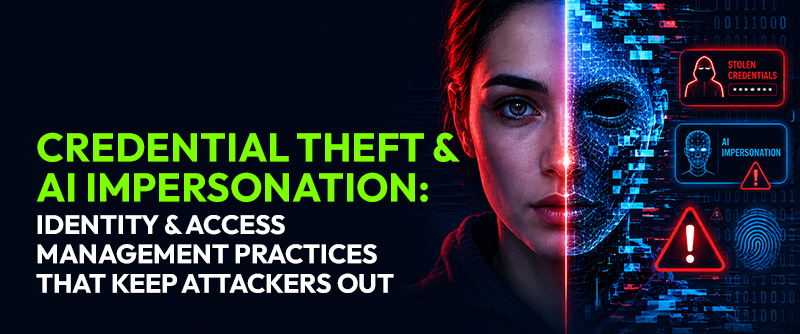
Stolen credentials remain the leading entry point for data breaches worldwide. Attackers no longer need to break through walls – they simply log in. As threats grow more sophisticated, strong identity and access management has moved from a technical preference to a business necessity. Organisations that overlook access controls expose themselves to financial loss, regulatory penalties, and reputational damage.
This blog breaks down the most effective practices security teams can adopt right now to protect identities, lock down access, and stay ahead of both credential theft and AI-powered impersonation attacks.
Understanding Today’s Threat Landscape
Why Credentials Are the Easiest Target
Usernames and passwords are everywhere. Employees reuse them, vendors store them insecurely, and databases leak them. Once an attacker has valid credentials, they move through systems quietly, blending in with legitimate traffic. Traditional perimeter defences were never built to catch this kind of activity.
Credential stuffing attacks, where stolen username-password combinations are tested across multiple platforms, are now largely automated. Attackers run millions of login attempts in hours. Even organisations with strong internal policies suffer when a third-party partner experiences a breach.
Password fatigue also plays a role. When employees manage dozens of accounts, shortcuts are created. Weak passwords, shared credentials, and skipped updates create entry points that attackers actively seek out and exploit.
How AI Raises the Impersonation Threat
Artificial intelligence has dramatically lowered the skill barrier for impersonation. Voice cloning tools can now replicate a colleague’s voice using just seconds of audio. Deepfake video technology is accessible and convincing enough to fool trained professionals working under time pressure.
Phishing and social engineering attacks have also grown sharper. AI tools help attackers craft personalised messages that mirror writing style, reference real projects, and arrive at psychologically precise moments. Generic phishing emails are giving way to targeted spear-phishing campaigns that are increasingly difficult to distinguish from legitimate internal communications.
The combination of stolen credentials and AI-generated impersonation creates a compounding risk. Attackers can steal access and then use deepfakes or cloned voices to bypass the human verification checks that organisations have long relied on as a backstop.
Best Practices Against Credential Theft
Enforce Phishing-Resistant MFA Everywhere
Standard SMS-based MFA is no longer sufficient. SIM-swapping attacks and real-time phishing proxies can intercept one-time codes in seconds. Hardware security keys and passkeys that use cryptographic binding to specific devices and domains provide meaningful protection.
Organisations should prioritise rolling out phishing-resistant MFA to privileged accounts, remote access gateways, and any system handling sensitive data.
Apply Least-Privilege and Just-in-Time Access
- Only grant permissions needed for the role at hand.
- Remove standing access to sensitive systems and replace it with time-limited, request-based access.
- Review service accounts and API keys regularly, as orphaned credentials are a persistent blind spot.
- Automate access reviews to remove permissions when roles change or employees leave the organisation.
Monitor for Credential Misuse Continuously
Detection matters as much as prevention. Behavioral analytics tools can flag unusual login times, impossible travel scenarios, and access patterns that deviate from an account’s established baseline. Alerts should trigger immediate review rather than sitting in a queue for a weekly audit.
Defending Against AI Impersonation
Build Identity Verification into High-Risk Workflows
Any workflow involving financial transfers, credential resets, or system access changes should require verified identity confirmation that goes beyond a simple email approval. Out-of-band verification through a pre-established, separate channel reduces the risk of an AI-generated message manipulating a sensitive process from start to finish.
Run Impersonation Awareness Training Regularly
- Teach staff to recognise cloned voices and deepfake videos during calls.
- Introduce code words or challenge phrases for sensitive internal requests.
- Simulate impersonation scenarios during security awareness exercises, not just traditional phishing simulations.
- Update training content quarterly as AI capabilities continue to evolve.
Deploy AI Detection Tools Inside Communication Channels
Security teams should integrate AI-generated content detection into email gateways, collaboration platforms, and internal communication tools. These tools are not perfect, but they add a layer of friction that disrupts low-effort impersonation attempts and flags suspicious patterns for human review.
Building a Zero Trust Access Framework
The Core Principle: Never Trust, Always Verify
Zero trust architecture operates on a foundational idea: no user, device, or system is trusted by default, regardless of whether they sit inside or outside the network perimeter. Every access request is evaluated in real time against identity, device health, location, and behavioural context before access is granted.
Practical Steps to Implement Zero Trust in Your Organisation
- Verify identity continuously, not just at login. Session-level re-authentication adds meaningful protection for long-running privileged sessions.
- Segment your network to contain lateral movement if credentials are compromised. Micro-segmentation limits how far an attacker can travel once inside.
- Enforce device trust policies. Only managed, compliant devices should be permitted to access sensitive systems.
- Log everything. Zero trust architecture depends on rich telemetry. Without comprehensive logging, verification becomes reactive rather than proactive.
- Integrate your IAM platform with endpoint detection, SIEM, and cloud access controls for a unified view of who is accessing what and when.
Progress does not require a full overnight overhaul. Start with the highest-risk access points and expand coverage systematically from there.
What to Do When a Breach Happens
Speed and containment are everything. Isolate the compromised account immediately. Revoke active sessions, reset credentials, and audit access logs from the previous 30 days to map lateral movement. Notify affected teams, preserve forensic evidence, and engage incident response procedures without delay. Post-incident reviews should focus on how access controls failed, not just how the attacker initially gained entry.
PhilSec: Where Practitioners Who Face These Threats Come to Learn
The practitioners defending against these threats need more than theory. They need practical, field-tested knowledge from peers who face the same challenges every day.
PhilSec brings together security professionals across the Philippines to share real experiences, proven frameworks, and hard-won lessons from the front lines of access security. From cybersecurity best practices sessions to in-depth technical workshops, the summit covers what matters most to working security teams operating in complex environments.
If protecting identities and access is part of the work, PhilSec is exactly where that conversation belongs.